
Support our independent tech coverage. Chrome Unboxed is written by real people, for real people—not search algorithms. Join Chrome Unboxed Plus for just $2 a month to get an ad-free experience, access to our private Discord, and more. Learn more about membership here.
START FREE TRIAL (MONTHLY)START FREE TRIAL (ANNUAL)
If you’ve been following along here at Chrome Unboxed over the past few months, the fact that detachable Googlebook tablets are officially on the way isn’t exactly surprising news. We’ve been digging through the Chromium Gerrit, tracking FCC and Bluetooth SIG filings, and piecing together the hardware pipeline long before the initial five launch devices actually showed up.
What is new, however, is that Google has finally stopped playing coy and just went ahead and made it official. During a developer keynote at the Android Dev Summit 2026, Google explicitly put it on the record from the stage, as reported by 9to5Google. Highlighting the hardware scope of the new operating system, Google announced that Googlebook is engineered to span across large-screen form factors from “clamshells, convertibles, and soon detachables.”
Hearing the platform team openly validate the form factor is an exciting milestone, turning our months of tracking into an acknowledged public roadmap.
‘Sapphire’ is waiting in the wings
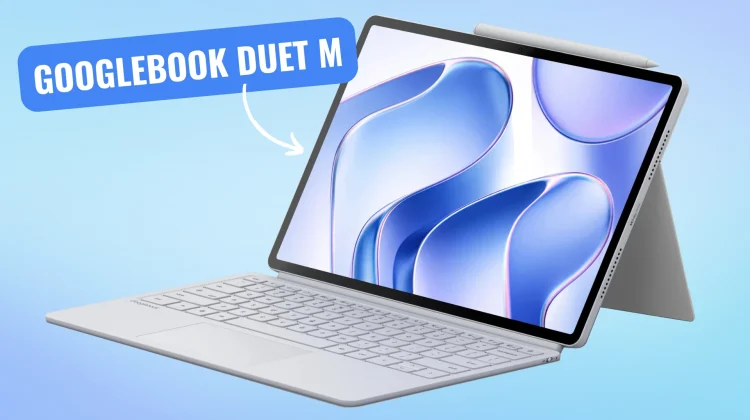
We’ve already uncovered tons of details surrounding ‘Sapphire’ – otherwise known as the upcoming the Lenovo Googlebook Duet m. When the Duet m’s detachable keyboard cleared the FCC along with the slews of other leaks around this device, it further confirmed everything we’re excited to see with this upcoming tablet: a 13-inch OLED panel, a dedicated kickstand, magnetic wireless stylus charging, dual USB-C ports, and an external Glowbar.
I’ve already covered why the Lenovo Duet m is my dream device, and why I’m glad it hasn’t launched yet, and this latest confirmation does little to change that over-arching story. Googlebook OS needs some serious cleanup before being deployed on a potentially game-changing device like the Duet m, so I’m very glad it didn’t launch alongside the clamshells last month.
‘Meru’ proves Lenovo isn’t the only player in the pipeline
Validating detachables on stage doesn’t just clear the runway for Lenovo’s MediaTek-powered slate; it also reinforces our discovery of other development boards brewing behind the scenes.
Back in August, we spotted an entirely separate project in the Chromium Gerrit codenamed ‘Meru’. Unlike the MediaTek silicon driving ‘Sapphire’, ‘Meru’ surfaced with clear signs of a Qualcomm Snapdragon X-series chip under the hood and plenty of unanswered questions to go along with it. We don’t know who’s making it, but we do know that a wirelessly recharging pen is part of the equation and we expect it to land a bit after Lenovo’s MediaTek-powered tablet.
Up until now, everyone evaluating Googlebook OS has been judging it purely on clamshells like the Lenovo Googlebook 15 or the single 360-degree convertible in the lineup, the $1099 Acer Googlebook 14. Testing the Acer on my desk has made the current software growing pains obvious: the Android 17-based desktop homescreen, app drawer, and Overview screen are still locked strictly to landscape orientation.
Google publicly affirming that detachable Googlebooks are on the way is a clear signal that there will be a clear intention around these devices moving forward. And that’s a good thing because there needs to be some stoking of the software fire. The potential for ultimate usability in a Googlebook tablet is incredible, but weird UI quirks, missing desktop productivity, and broken UX elements could add to the growing aggravation around this fledgling platform. Here’s hoping Google gets things ironed out before the Duet m arrives.
SUBSCRIBE TO UPSTREAM
Get Chrome Unboxed delivered straight to your inbox
Upstream is our flagship, curated newsletter with the top stories, most click-worthy deals, giveaways, and trending articles from Chrome Unboxed sent directly to your inbox a few times a week. Join 31,000+ subscribers.

