
Support our independent tech coverage. Chrome Unboxed is written by real people, for real people—not search algorithms. Join Chrome Unboxed Plus for just $2 a month to get an ad-free experience, access to our private Discord, and more. Learn more about membership here.
START FREE TRIAL (MONTHLY)START FREE TRIAL (ANNUAL)
When The Mac Observer published its scoop on the Lenovo Googlebook 15 last week, my eyes went straight to the possible naming of the underlying OS for Googlebook and the other confirmed features.
Between the 120Hz 2.8K OLED display, the Intel Core Ultra 5 Panther Lake silicon, the haptic trackpad, and the likely confirmation that the platform software is will be called Googlebook OS, there was alto to absorb. In the midst of processing all the new info, I completely skimmed right past one subtle line on Lenovo’s spec sheet that might actually be the one of the most exciting hardware reveals of the entire package: “Google facial authentication.”
Lenovo didn’t just list a fingerprint reader on the deck; they explicitly called out facial recognition right alongside it. If this is what it sounds like, we might be looking at the first real-world deployment of Google’s long-rumored Project Toscana.
Connecting the dots to Project Toscana
According to early reports, Google has been developing an overhauled hardware-assisted face unlock system engineered to work as quickly and reliably as Apple’s Face ID across varied lighting environments, all while avoiding bulky sensor notches. Crucially, the original report specifically noted that Project Toscana was being built not just for future Pixel phones, but for laptops as well.
Seeing Lenovo explicitly list “Google facial authentication” as a dedicated security feature on a flagship Googlebook suddenly makes all of those reports click right into place.
The notch that isn’t just an aesthetic choice
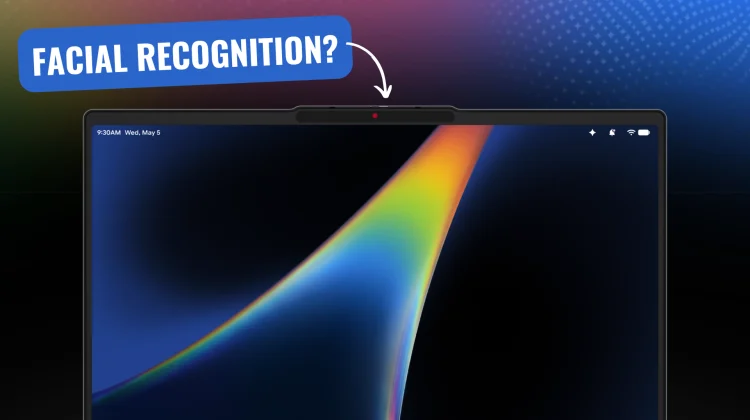
Looking back at our analysis of the leaked Lenovo Googlebook 15 renders from August, there is a distinct design quirk on the top display bezel that Lenovo has been utilizing on other Google-based laptops for the past year or so.
That slightly raised camera bump houses a 5MP webcam, dual microphones, and a physical privacy shutter. But as I noted at the time, there appeared to be space for some extra sensor hardware tucked into that housing beyond a standard RGB webcam lens.
If Lenovo is deploying dedicated IR flood emitters or depth sensors beneath that bezel, it would solve the single biggest pain point of Android’s modern camera-only Face Unlock: failure in dimly lit rooms.
On a smartphone, pulling your hand out of your pocket to tap a fingerprint sensor is second nature. On a laptop, however, seamless facial authentication would be a game-changer. Windows Hello has spoiled PC users for years with instant logins the second you open the lid, and MacBook users have spent years begging Apple to bring Face ID to macOS.
If Googlebook launches out of the gate with secure, instant, zero-touch facial authentication that logs you straight into your desktop and authenticates secure passes, it immediately elevates the platform into true luxury territory.
We find out tomorrow morning
Whether “Google facial authentication” represents the full-blown, hardware-backed fruition of Project Toscana or an ultra-refined software implementation borrowing from Pixel’s biometric algorithms remains to be seen.
Either way, the fact that Google and Lenovo are prioritizing biometric convenience on Day One proves how seriously they are treating this launch. We are on the ground in New York City later this evening preparing for tomorrow morning’s media showcase, and you can bet that testing out this camera setup will be one of the very first things I do once we get hands on the hardware!
SUBSCRIBE TO UPSTREAM
Get Chrome Unboxed delivered straight to your inbox
Upstream is our flagship, curated newsletter with the top stories, most click-worthy deals, giveaways, and trending articles from Chrome Unboxed sent directly to your inbox a few times a week. Join 31,000+ subscribers.

