
Support our independent tech coverage. Chrome Unboxed is written by real people, for real people—not search algorithms. Join Chrome Unboxed Plus for just $2 a month to get an ad-free experience, access to our private Discord, and more. Learn more about membership here.
START FREE TRIAL (MONTHLY)START FREE TRIAL (ANNUAL)
A newly updated Google support document has been making the rounds this week, sparking a fresh wave of conversation across the web regarding the long-term future of Chromebooks. The documentation covers two significant details: confirming that several recent Chromebook models will be eligible to migrate over to Googlebook OS, while detailing that updates for the standard ChromeOS platform are slated to continue through 2034.
For anyone who missed this initial news earlier this year, seeing these timelines in print can feel like a major shift. But if you have been following along with our coverage here, this roadmap is nothing new and not surprising at all. Rather than an abrupt pivot, Google is simply formalizing the exact transition strategy they shared with us earlier this year.
What the new enterprise support document outlines
The document in question comes from an official Google Enterprise Support page aimed at IT administrators preparing their networks for the arrival of Googlebook hardware. Among the operational questions about deployment, licenses, and management policies, Google explicitly confirms “many of our newest Chromebook devices will be eligible to transition over to Googlebook OS.”
Alongside that confirmation, the documentation outlines support horizons that stretch through 2034. For organizations and everyday consumers alike, that dual message provides some clarity as Google is establishing a software bridge for capable existing hardware, while continuing to support the traditional ChromeOS fleet for years to come.
A plan months in the making
While this is making headlines across the web this week, Google’s team has been transparent about this path since the beginning of the year. Back in January, Google’s VP of ChromeOS John Maletis told us directly that an upgrade pathway was in active development for capable hardware, emphasizing that they wanted to allow migrations wherever possible with “product truth.”
We followed up on that plan again in May after Google first pulled back the curtain on the Googlebook platform. At the time, Google’s Charles Lee gave us a statement that mirrors almost word-for-word what is now written in the official enterprise documentation:
“Chromebooks have become an invaluable tool for educational institutions, businesses, and consumers throughout the globe, bringing powerful features, security, and simple-to-use management tools for commercial users. We absolutely intend to continue investing in those experiences and supporting those users. We’re excited for the upcoming Chromebooks in the pipeline. And of course, all Chromebooks will continue to receive support through their device’s existing date commitment, and many Chromebooks will be eligible to transition to the new experience. We’ll share more details closer to launch.”
Bryan Lee, VP of ChromeOS Enterprise Go-to-Market
Seeing this confirmed in formal documentation is great validation of what the ChromeOS leadership team pledged months ago, giving current hardware owners solid ground to stand on.
Understanding the 2034 support horizon
The 2034 timeline has caught some readers by surprise, but the context behind that number is straightforward. In the fall of 2023, Google established a guarantee providing 10 years of automatic software and security updates for all Chromebooks launched from 2021 forward.
A 10-year support window carries anything based on a 2024 development board directly to 2034 – and newer devices like the Lenovo Chromebook Plus 14 will be in the group that can make the transition to Googlebook OS for the last year of promised updates (that devices gets ChromeOS updates until June of 2025 for example).
It is not an arbitrary shutdown date or a premature end of life; it is Google honoring the full decade-long commitment made to schools, businesses, and everyday buyers. ChromeOS remains the backbone for millions of education and enterprise deployments, and Google is ensuring those fleets remain secure and fully functional for their entire expected lifespan.
What to expect for your hardware
While Google has not released a comprehensive list of specific models that will be qualified to make the jump to Googlebook OS just yet, the hardware requirements tell a clear story. Googlebook OS brings an Android-first architecture with multi-window desktop environments, native apps, and heavy on-device Gemini features that demand modern processing power. Here’s our bet on the types of Chromebooks that will and won’t be able to make the switch:
- Chromebook Plus and recent premium hardware: Models equipped with Intel Core Ultra, 13th-Gen Core processors, higher-end MediaTek Kompanio Ultra, and 8GB to 16GB of RAM are the primary candidates suited for the optional migration to Googlebook OS.
- Entry-level and education models: Clamshells built around entry-tier processors and 4GB of RAM will remain comfortably on ChromeOS, receiving uninterrupted security patches and browser updates through their published Auto Update Expiration (AUE) dates.
If you recently invested in a high-end Chromebook or a Chromebook Plus model, you are well-positioned for the future via a move to Googlebook OS or many years of updates to ChromeOS. And if you rely on a budget-friendly Chromebook for daily web tasks, nothing changes about the dependability of your device, either.
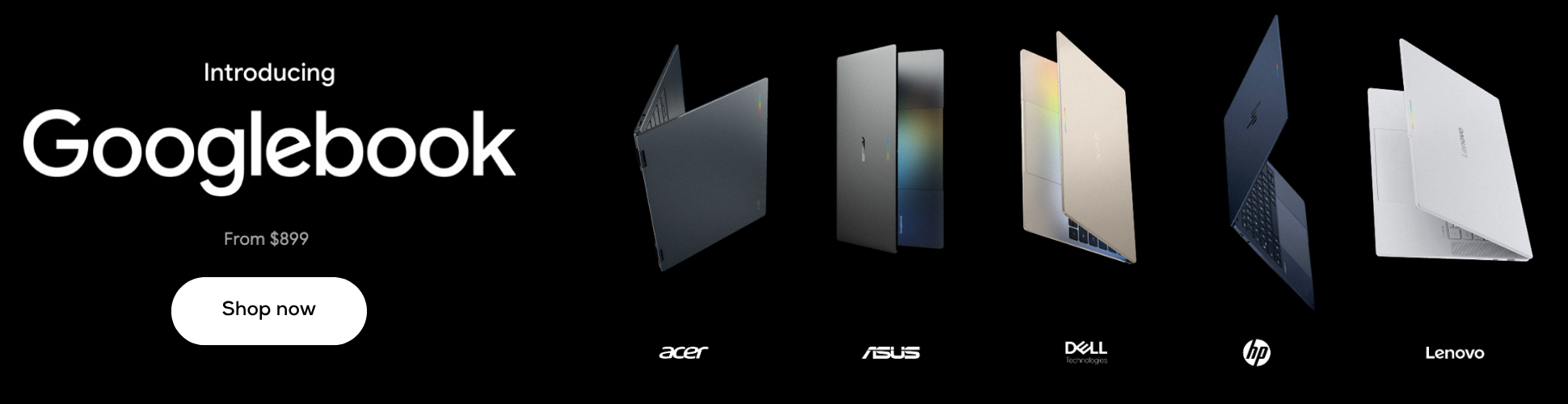
With the first retail Googlebook laptops from Acer, ASUS, Dell, HP, and Lenovo scheduled to hit shelves on October 4, I’m hopeful that the migration path for existing Chromebooks becomes more clear in the coming weeks and months. As we learn more, we’ll keep you updated.
SUBSCRIBE TO UPSTREAM
Get Chrome Unboxed delivered straight to your inbox
Upstream is our flagship, curated newsletter with the top stories, most click-worthy deals, giveaways, and trending articles from Chrome Unboxed sent directly to your inbox a few times a week. Join 31,000+ subscribers.

