
Support our independent tech coverage. Chrome Unboxed is written by real people, for real people—not search algorithms. Join Chrome Unboxed Plus for just $2 a month to get an ad-free experience, access to our private Discord, and more. Learn more about membership here.
START FREE TRIAL (MONTHLY)START FREE TRIAL (ANNUAL)
Ever since Google officially pulled back the curtain on Googlebook at The Android Show back in May, one question has dominated across the board: is Google going to make their own Googlebook?
It’s a natural reaction. Chromebook users have loved Google’s first-party hardware throughout the years. Whenever Google announces a major shift in the overall strategy for their laptops, the immediate impulse is to ask when the shiny new flagship hardware with a Google logo on the lid is going to show up.
When we sat down with Google VP John Maletis to talk all things Googlebook, we couldn’t resist asking the question we’ve asked so many times before: is Google considering first-party hardware for this new platform? And while he gave his classic, polished response, stating he couldn’t comment on first-party hardware roadmaps, the broader implication remains unchanged. Not right now. But not never, either.
The strategic history of first-party Google laptops
If you look back at the history of ChromeOS, Google entering the hardware space directly was never about competing with its manufacturing partners for market share. It was always about lighting the path during pivotal moments when the ecosystem needed a directional push. I talked about this exact dynamic years ago when exploring why a Tensor-powered Pixelbook wasn’t happening, and the pattern holds completely true today:
- The original Chromebook Pixel (2013 and 2015): Built simply to prove that a web-based laptop could feel like luxury hardware, introducing high-res touchscreens and premium aluminum chassis to a category that was previously dominated by cheap plastic.
- The Pixelbook (2017): Ushered in the era of ultra-premium 2-in-1 convertibles, showing OEMs how Android apps and stylus support could transform the ChromeOS workflow.
- The Pixel Slate (2018): A bold attempt to push ChromeOS into the detachable tablet space with a touch-first interface.
- The Pixelbook Go (2019): A deliberate course correction designed to show partners how to build a clean, minimal, incredible-feeling laptop at a practical price point.
Working with partners from day one
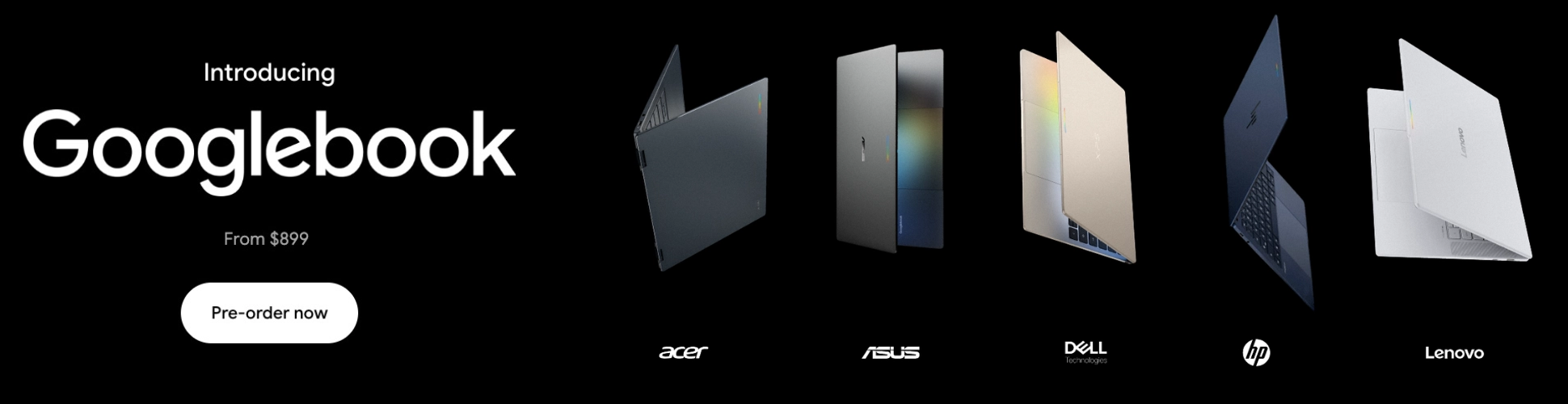
With Googlebook, Google seems to be sticking to that exact same playbook. The goal right now isn’t to step on the toes of partners like Acer, ASUS, Dell, HP, and Lenovo; it’s to work closely with them to build an incredible, premium launch lineup.
Google has set up strict baseline hardware standards for Googlebook, giving OEMs a clear blueprint to build stunning devices. Pushing its own first-party hardware into the market on day one would only create unnecessary friction with the very partners tasked with scaling this new ecosystem.
Unless Google reaches a future milestone where it needs to radically redefine what a Googlebook can do, first-party hardware simply isn’t necessary. The OEMs are stepping up in a huge way to handle the hardware, and we expect to see at least 8 devices in the first Googlebook wave at launch.
The hilarious naming conundrum
There is a pretty fun hypothetical to be had, here: what if Google does eventually decide to build its own Googlebook down the road a bit. What on earth would they actually call it? When you step back and look at Google’s current branding structure, the naming scheme gets pretty messy very quickly:
- Google Googlebook? I don’t think I need to say anything, here.
- Pixelbook Googlebook? Stacking two completely different brand suffixes together sounds silly.
- Googlebook Pixel? This one actually has a bit of a ring to it, following the convention of hardware lines like the Pixel Tablet or Pixel Watch, but it still feels a little clunky.
When I brought up the naming dilemma to John Maletis during our interview, even he couldn’t help but chuckle at how silly “Google Googlebook” sounded. And for now, we don’t have to worry about marketing team headaches in Mountain View. Google is letting its hardware partners take center stage for the launch of Googlebook this fall, and based on what we’ve seen so far, the ecosystem looks to be in very capable hands.
SUBSCRIBE TO UPSTREAM
Get Chrome Unboxed delivered straight to your inbox
Upstream is our flagship, curated newsletter with the top stories, most click-worthy deals, giveaways, and trending articles from Chrome Unboxed sent directly to your inbox a few times a week. Join 31,000+ subscribers.

