

Support our independent tech coverage. Chrome Unboxed is written by real people, for real people—not search algorithms. Join Chrome Unboxed Plus for just $2 a month to get an ad-free experience, access to our private Discord, and more. Learn more about membership here.
START FREE TRIAL (MONTHLY)START FREE TRIAL (ANNUAL)
Now that the dust has settled from the announcements at last month’s Snapdragon Summit, we’re left with two solid facts: the Android and ChromeOS merger is real, and it’s coming next year. But beneath those confirmations lies a massive, convoluted branding problem that Google now has to solve. For over a decade, Google has branded both the hardware (“Chromebook”) and the software (“ChromeOS”), but I think that with this fundamental platform shift, that entire structure has to change.
Now, I recognize that it’s early and this might all be a bit too soon to speculate. And to be perfectly clear, I don’t have any inside information here. But this is the single largest shift in the platform we have ever seen, and it’s a topic worth exploring. We’ve been covering this space for a very long time—all the way back to 2013 when Robby was unboxing the first Chromebooks on his kitchen floor. So yes, while this is speculative, my goal is to promote an informed discussion.
Why ‘ChromeOS’ and ‘Chromebook’ have to go
To understand the problem, we just need to look at how Apple and Microsoft handle their ecosystems. Apple is vertically integrated; they make the hardware and the software, so a single “MacBook” brand running “macOS” is simple. Microsoft, on the other hand, makes the Windows software platform for a huge variety of hardware partners like Dell, HP, and Lenovo, while also making its own first-party “Surface” line.
Google currently finds itself more in the Microsoft camp here. And in this new world of Android and ChromeOS merging, the names “ChromeOS” and “Chromebook” are no longer accurate. The new OS isn’t based on Chrome; Chrome will simply be a very important app running on an Android foundation. I think keeping the “ChromeOS” name would be misleading and would do nothing to shed the “just a browser” stigma the platform has fought for years.
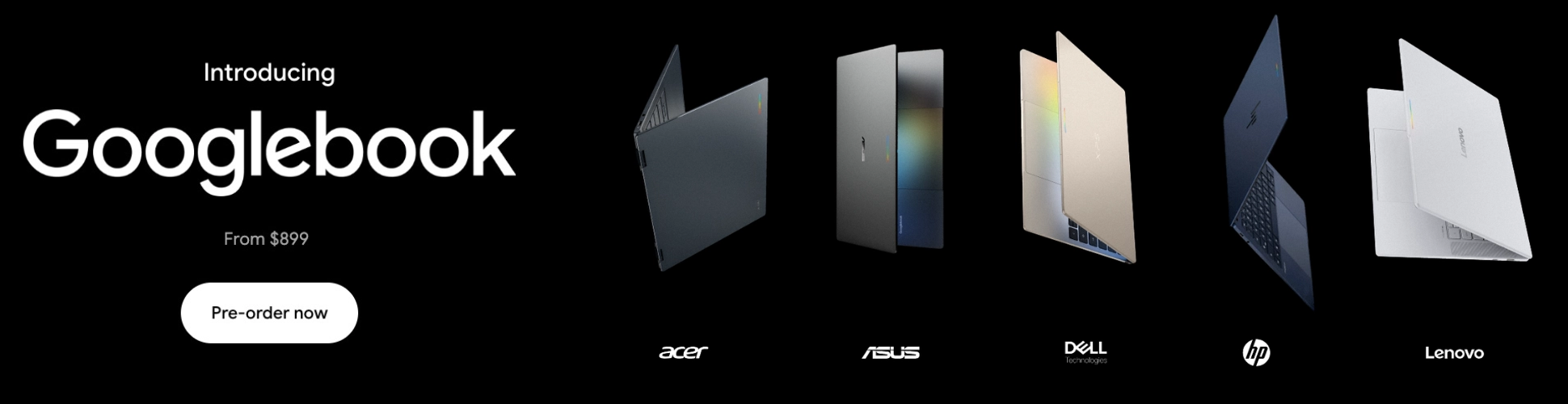
The same is true for the “Chromebook” hardware brand. If Google forced all of its partners—Lenovo, HP, Acer, etc.—to call their new devices “Chromebooks,” it would be the equivalent of Microsoft forcing every PC maker to call their laptops a “Surface.” It just doesn’t make a ton of sense with this new merged OS.
So, what will the new OS be called?

From my perspective, the answer is right in front of us: Android. It’s the core of everything Google does. Just as we have Android TV and Android Auto, the most logical name for this new platform would simply be Android. It’s clear, descriptive, and leverages Google’s most powerful brand.
Our Chrome Unboxed Plus community had some fun with this, throwing out names like GeminiOS and SparkOS, but the simple, established “Android” branding feels like the most likely path forward.
What will the laptops be called?
This is where the Microsoft model really comes into play. Google doesn’t have to brand the third-party hardware at all in this new world. Manufacturers will simply build and brand their own laptops—the Lenovo Duet, the Samsung Galaxy Book—and they will be marketed as being “powered by Android.” This is exactly how the Android phone, tablet, and watch markets already operate.
This then clears the path for Google to launch its own flagship hardware to showcase the new OS. And all signs point to this happening. We’ve been tracking a new tablet that will likely be in the Made by Google family, codenamed Sapphire, that features a lightbar reminiscent of the 2013 and 2015 Chromebook Pixels.
This feels like the first in a new line of premium, first-party devices. Hopefully, this means the return of the Pixel Tablet, now with the new OS, and/or the launch of a Pixel Laptop, which has also been rumored. The biggest benefit here is that these devices would finally be back in the main “Made by Google” portfolio, hopefully receiving the broader marketing budgets and promotion they deserve.
The long transition
Of course, we still have to consider the tens of millions of Chromebooks out there right now in the enterprise and education markets that Google is contractually obligated to continue supporting; they won’t just disappear. We fully expect that the existing devices that can’t handle the new OS will continue to receive security and feature updates on the legacy ChromeOS for the remainder of their 10-year support window.
My bet is that we are about to enter a new era of powerful, diverse laptops from all our favorite manufacturers, all likely being “powered by Android.” I don’t envy Google’s task of rearranging and marketing all of this, but it’s a necessary and exciting step! So, what are your thoughts? Let me know in the comments.
SUBSCRIBE TO UPSTREAM
Get Chrome Unboxed delivered straight to your inbox
Upstream is our flagship, curated newsletter with the top stories, most click-worthy deals, giveaways, and trending articles from Chrome Unboxed sent directly to your inbox a few times a week. Join 31,000+ subscribers.

