
Support our independent tech coverage. Chrome Unboxed is written by real people, for real people—not search algorithms. Join Chrome Unboxed Plus for just $2 a month to get an ad-free experience, access to our private Discord, and more. Learn more about membership here.
START FREE TRIAL (MONTHLY)START FREE TRIAL (ANNUAL)
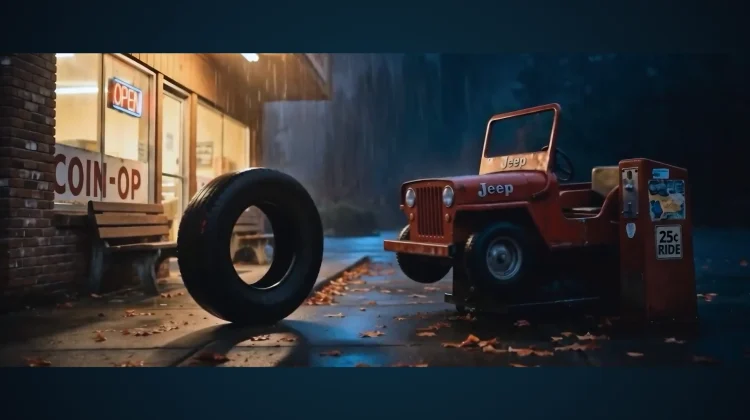
It is a genuinely strange feeling to watch a commercial, realize you are being emotionally moved by the narrative, and then discover that absolutely none of the footage was shot with a real camera. It is even stranger when the protagonist pulling on your heartstrings is a discarded car tire. You can’t make this stuff up.
But that is exactly what Jeep has pulled off, and it represents what feels like a true watershed moment for the capabilities of AI video generation and what these new creative tools are actually capable of.
The new ad, which recently premiered during the Cannes Lions festival, takes a page straight out of the Pixar storytelling playbook. It gives agency and human-like emotion to an inanimate object, following a lone tire as it traverses a rugged, lonely landscape in search of a new home. When watching it, it is hard to deny the emotional weight of the journey, and that truly makes the underlying technology that built it all the more staggering. Take a second to view it below if you can.
Powered by Google Veo and Luma Dream Machine
The truly ground-breaking part of this campaign isn’t just the story; it is the execution of the vision. The entire commercial was generated using AI, relying heavily on Google’s new Veo model alongside Luma Dream Machine.
According to the creative agency behind the project – Highdive – these advanced AI models were used throughout the entire development pipeline. The AI handled scouting digital locations, developing the core characters, and generating the final broadcast-ready scenes. Because this is an official Jeep campaign, the team had to ensure the vehicles were rendered with millimeter-level product accuracy. They achieved that precision without ever putting a physical car on a physical set.
Hiding the flaws to highlight the magic
What makes this such a massive milestone for AI video is the sheer quality and fidelity of the final product. The shots do not look like a quirky, uncanny valley AI experiment; they look like a premium, big-budget automotive campaign.
The creative team made an incredibly smart structural decision to achieve this: they largely avoided humans. Right now, AI is most obviously noticed when rendering human faces, complex eyes, and micro-expressions. By focusing the narrative entirely on a solitary tire and sweeping landscapes (save for a brief, distant human cameo at the end), they completely bypassed the technology’s current weak points.
We have been talking about the potential of platforms like Google Veo for quite some time now, but seeing it deployed to evoke genuine, human-like emotion from an old tire proves we are crossing a new threshold. This isn’t just a neat tech demo anymore. When this technology is used at a high-level like this by talented storytellers, the results can be truly spectacular. Well done, Highdive. This is art.
SUBSCRIBE TO UPSTREAM
Get Chrome Unboxed delivered straight to your inbox
Upstream is our flagship, curated newsletter with the top stories, most click-worthy deals, giveaways, and trending articles from Chrome Unboxed sent directly to your inbox a few times a week. Join 31,000+ subscribers.

