
Support our independent tech coverage. Chrome Unboxed is written by real people, for real people—not search algorithms. Join Chrome Unboxed Plus for just $2 a month to get an ad-free experience, access to our private Discord, and more. Learn more about membership here.
START FREE TRIAL (MONTHLY)START FREE TRIAL (ANNUAL)
If you spent your Tuesday afternoon watching the Google I/O 2026 opening keynote, it was easy to get swept up in the jaw-dropping scale of Google’s AI automation. Sundar Pichai and his team spent a massive chunk of stage time showing off things like Gemini Spark (a 24/7 personal assistant running on dedicated data centers that handles your digital chores while you sleep) and the sheer reasoning muscle of the upcoming Gemini 3.5 Pro model.
But if you look past the flashy, expensive cloud agents and dive straight into the meat of the announcements, the real star of the show emerged. And it’s the exact model that is going to make the first wave of Googlebooks absolutely amazing this fall: Gemini 3.5 Flash.
The limits of local silicon
For the past week, we have been covering Googlebooks, the underlying Android tech stack driving them, and how Google is transforming the platform from a standard operating system into an “intelligence system.”
To make that happen smoothly on-device, Googlebooks will rely heavily on an upgraded, on-device iteration of Gemini Nano. Nano is the AI model that sits right on your local storage, using the laptop’s physical Tensor Processing Unit (TPU) to handle instantaneous, offline tasks. For example, when you use the new Magic Pointer to instantly grab a phone number off a webpage or use Rambler to clean up your voice dictation, Gemini Nano handles it locally so your battery life doesn’t take a hit and your data stays private.
But local silicon has limits. If you ask the laptop to code an entire custom Generative UI widget on your desktop from scratch, or ask Gemini to cross-reference a massive pile of PDF invoices, local models can hit a wall. The system has to hand that heavy computing off to the cloud; and that is exactly where the cloud-based Gemini 3.5 Flash comes in to save the day.
Crushing the cloud latency bottleneck
When a laptop operating system has to pause what it’s doing to send a request to a cloud server, the biggest threat to a premium user experience is round-trip latency. If you trigger an OS gesture and have to stare at a loading spinner for three seconds while a heavy server miles away thinks about the answer, the experience is marred a bit.
Gemini 3.5 Flash relieves that bottleneck. Google co-optimized 3.5 Flash specifically for high-speed, parallel agent execution loops. According to the keynote details, the model clocks in at an astonishing four times faster than other frontier models on the market, generating nearly 1,500 tokens per second. In pure coding and agentic reasoning benchmarks, it doesn’t just iterate on older lightweight builds; it actively outperforms Gemini 3.1 Pro.
By leveraging 3.5 Flash as the cloud infrastructure layer for Googlebook, Google has built a seamless tag-team ecosystem. Gemini Nano handles the light, instantaneous on-device interactions. The second a task requires heavy-duty reasoning, it scales up to the cloud, where 3.5 Flash processes the request so quickly that the response will drop back onto your desktop almost instantly.
The perfect engine for featherweight portables
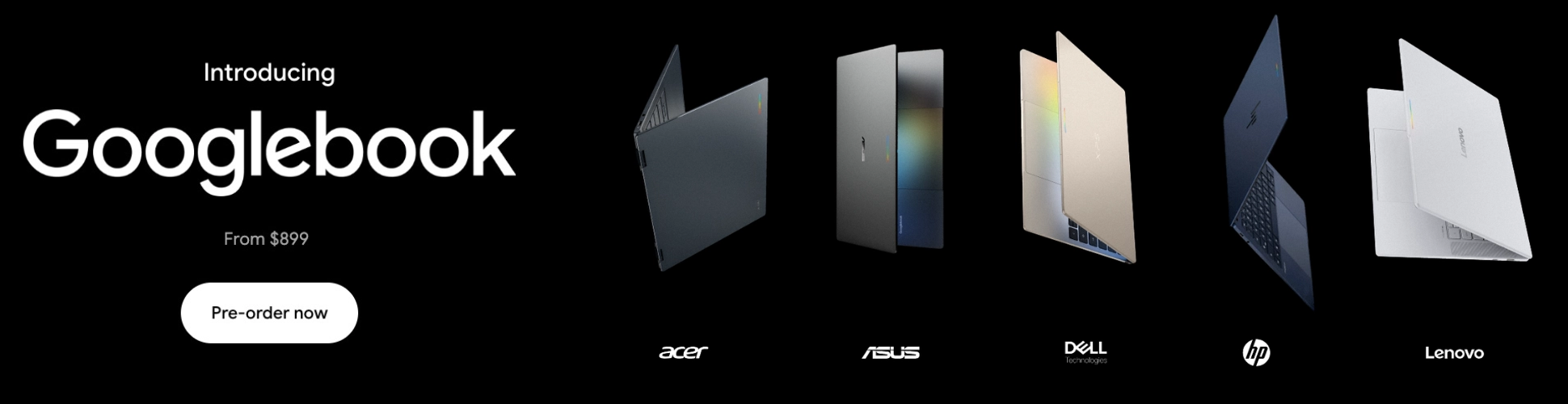
When Google launched the official Googlebook landing page this week, they prominently debuted a new marketing tagline: “Featherweight design. Heavyweight power.” We already know the initial fall wave of laptops from Acer, ASUS, Dell, HP, and Lenovo will be premium, thin, and light form factors powered by next-generation silicon from Qualcomm, Intel, and MediaTek.
In a portable chassis like that, balancing processing power, thermal efficiency, and battery life is of absolute importance. By anchoring their cloud hand-offs to a model as lightning-fast and structurally efficient as 3.5 Flash, Google ensures that these laptops don’t have to stay perpetually tethered to massive, power-hungry local compute cycles to feel incredibly smart; and we’ll get to see them in action very soon!
SUBSCRIBE TO UPSTREAM
Get Chrome Unboxed delivered straight to your inbox
Upstream is our flagship, curated newsletter with the top stories, most click-worthy deals, giveaways, and trending articles from Chrome Unboxed sent directly to your inbox a few times a week. Join 31,000+ subscribers.

