Support our independent tech coverage. Chrome Unboxed is written by real people, for real people—not search algorithms. Join Chrome Unboxed Plus for just $2 a month to get an ad-free experience, access to our private Discord, and more. Learn more about membership here.
START FREE TRIAL (MONTHLY)START FREE TRIAL (ANNUAL)
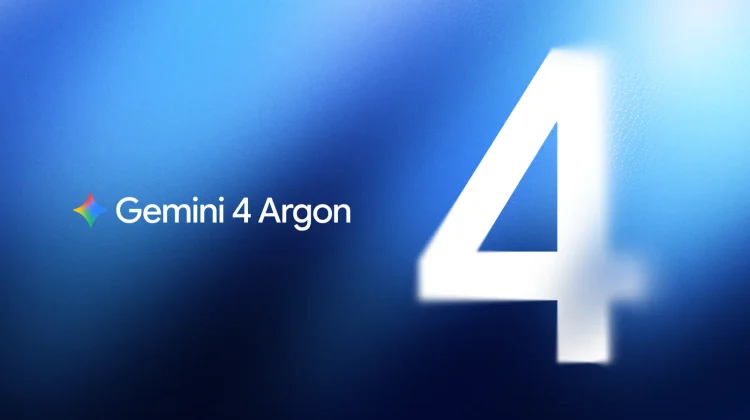
Google DeepMind has officially unveiled its next major frontier model: Gemini 4 Argon. While consumer artificial intelligence over the past couple of years has largely centered on conversational chatbots, image generation, and quick writing assistance, Argon is engineered for a completely different tier of computing: deep reasoning across complex, long-horizon workflows.
Instead of merely generating fast answers to single prompts, Argon is built to sustain multi-step tasks across real-world software engineering, defensive cybersecurity, and enterprise knowledge work without losing context or derailment.
Here is what makes Gemini 4 Argon a significant milestone, how Google is already deploying it internally, and where it fits into the broader AI software landscape.
Expanded output ceiling for sustained, deep reasoning
The standout technical leap in Gemini 4 Argon is a massive expansion of its output ceiling to an industry-leading 1 million tokens: a substantial leap over the 64,000-token limit of previous generations.
In practical terms, output capacity represents the digital workspace a model has to reason through a problem. When an AI model is constrained by small output buffers, it is forced to deliver abbreviated answers or fragment complex tasks into tiny chunks.
With the headroom to generate hundreds of thousands of tokens in a single run, Argon can think through elaborate problems, test logic, audit entire enterprise codebases, and deliver fully realized solutions in one continuous trajectory.
What Argon is already doing inside Google
Rather than confining the model to laboratory benchmarks, Google has been actively running Gemini 4 Argon across its own engineering and infrastructure teams:
- Large-Scale Codebase Migrations: Modernizing legacy C and C++ codebases into memory-safe languages like Rust is a massive undertaking. Argon agents are actively handling these migrations across critical systems at Google, including core media libraries and up to 800,000+ lines of the Fuchsia Zircon kernel. In libgav1 (Google’s open-source video decoder), Argon optimized the Rust code so effectively that the compiler vectorized it automatically, resulting in an implementation that runs 2.7 times faster while maintaining identical output.
- Data Center Resource Optimization: Autonomous teams of Argon agents analyzed telemetry across Google’s server fleet, identifying and deploying memory optimizations that freed up over 300 terabytes of memory, with projected savings scaling up to 1 petabyte.
- Autonomous Vulnerability Discovery and Patching: In cybersecurity, Argon is built to autonomously discover, validate, and remediate critical flaws. Partnering with security firm Wiz through its Scan for Good initiative, the model identified an active, severe vulnerability exposing sensitive data in hospital software worldwide: a flaw that earlier frontier models missed entirely.
What this means for users and the broader ecosystem
Because frontier models with this level of autonomy require intense compute power and strict safeguards, Google is taking a phased rollout approach. Argon is currently accessible to vetted cyber defenders through Google’s Fairwind Program, with availability expanding next to developers via paid API tiers and Google AI Ultra subscribers. For everyday users, the impact of Gemini 4 Argon will ripple outward in two primary ways:
- More Resilient Consumer Services: When autonomous models can continuously audit, optimize, and patch software behind the scenes, web platforms, mobile operating systems, and banking apps become fundamentally faster, more stable, and less vulnerable to zero-day security exploits.
- Technological Trickle-Down: The architectural breakthroughs achieved on flagship models like Argon don’t stay locked in data centers for long. The reasoning efficiencies and agentic workflows developed here will eventually be put to work in the smaller, more efficient Gemini models that power everyday tools on your phone, web browser, and Googlebook.
SUBSCRIBE TO UPSTREAM
Get Chrome Unboxed delivered straight to your inbox
Upstream is our flagship, curated newsletter with the top stories, most click-worthy deals, giveaways, and trending articles from Chrome Unboxed sent directly to your inbox a few times a week. Join 31,000+ subscribers.

