
Support our independent tech coverage. Chrome Unboxed is written by real people, for real people—not search algorithms. Join Chrome Unboxed Plus for just $2 a month to get an ad-free experience, access to our private Discord, and more. Learn more about membership here.
START FREE TRIAL (MONTHLY)START FREE TRIAL (ANNUAL)
The multiple surrounding Google’s upcoming Project Aluminium – the ambitious move of ChromeOS to the Android kernel – have given us a clear look at the future of the what Chromebook hardware is set to become. We’ve seen glimpses of this new desktop UI running on existing Chromebooks and identified the first flagship development boards like ‘Sapphire,’ ‘Ruby,’ and Acer’s ‘Moonstone.’
But today, we have yet another significant piece of the puzzle put in place: a specific expiration date for ChromeOS. According to recently surfaced court documents from Google’s search antitrust case, Google plans to officially phase out ChromeOS by 2034.
End of Life
The discovery, first reported by The Verge, comes from internal Google transcripts and legal filings. And that 2034 date isn’t arbitrary; it is directly tied to Google’s landmark promise to provide 10 years of automatic updates for every Chromebook.
Google’s lawyers admitted in court that “Aluminium OS” will not be compatible with all existing Chromebook hardware. Because Google is legally and contractually obligated to support those older devices for at least a full decade, they must maintain the “legacy” ChromeOS stack until the very last supported device reaches its end-of-life. Once that window closes, ChromeOS as we know it today will likely be retired.
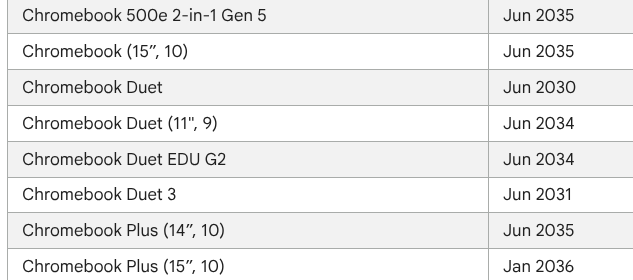
However, the 2034 date doesn’t line up with the latest hardware that was just released at CES 2026. On Google’s own support page that lists all device AUEs, we can clearly see devices that are supported will into 2035 at this point. While there’s a chance that we don’t get any new standard Chromebooks after this latest batch, I’m not convinced that will actually be the case.
Will ‘Aluminium’ really take until 2028?
Another slightly controversial part of the court documents is the launch timeline for the new OS. The filings suggest that while “commercial trusted testers” will get a version of Aluminium in late 2026, a “full release” – specifically for the critical enterprise and education sectors – might not happen until 2028.
Now, it’s worth taking that 2028 date with a grain of salt. These documents were part of a high-stakes antitrust trial where Google was fighting to prevent the forced sale of Chrome. In that context, it was in Google’s best interest to paint the transition as “slow, difficult, and messy” to argue that only Google could successfully manage the support requirements for existing users.
Given the high level of polish we’ve already seen in the leaked “ALOS” builds and the fact that flagships are already far along in development via hints from the Chromium Gerrit, we suspect the actual consumer rollout could happen much faster than the conservative 2028 date suggested to the courts. We’re still holding onto a 2026 reveal for sure.
Why the “Aluminium” merger may have saved Chrome
Interestingly, these documents reveal that ChromeOS was the key reason Google was allowed to keep the Chrome browser. Google’s lawyers successfully argued that if the company were forced to sell Chrome, it would be impossible to maintain the software support required for millions of students and businesses currently using Chromebooks.
Furthermore, the judge’s final ruling created a massive win for the future of the ‘Aluminium’ project. While Google is now restricted from making certain self-preferencing deals on Android phones, ChromeOS and its “successor” (Aluminium) are exempt. This means Google can continue to prioritize its own apps and the Gemini experience on its new desktop platform without the same legal hurdles facing its mobile business.
What this means for users
If you’ve recently purchased a Chromebook Plus or one of the newer devices we’ve been tracking, you aren’t in any immediate peril. Google has made it clear that “modern” hardware will be given a migration path to the new Android-based stack as it matures.
For everyone else, we at least know roughly how much time is left on the clock for the original ChromeOS architecture. We are witnessing a 10-year transition where Google will slowly bridge the gap between the web-centric world of today and the AI-native, Android-powered desktop of tomorrow. It’s going to be a wild ride.
SUBSCRIBE TO UPSTREAM
Get Chrome Unboxed delivered straight to your inbox
Upstream is our flagship, curated newsletter with the top stories, most click-worthy deals, giveaways, and trending articles from Chrome Unboxed sent directly to your inbox a few times a week. Join 31,000+ subscribers.

