
Support our independent tech coverage. Chrome Unboxed is written by real people, for real people—not search algorithms. Join Chrome Unboxed Plus for just $2 a month to get an ad-free experience, access to our private Discord, and more. Learn more about membership here.
START FREE TRIAL (MONTHLY)START FREE TRIAL (ANNUAL)
Just as the dust was beginning to settle on our confirmation that Lenovo is building the ARM-powered ‘Sapphire’ flagship detachable for the ‘Aluminium’ project, we have a second contender also in the works to help carry the mantle of this massive shift in laptop strategy from Google.
Thanks to some clear-cut evidence in the Chromium repositories, we can now officially confirm that Lenovo is also building ‘Ruby’ – a high-performance Intel Panther Lake device we’ve recently begun tracking as part of Google’s ‘Aluminium’ project.
If ‘Sapphire’ is the thin-and-light, high-efficiency detachable designed to showcase the portability of the new Android-based ChromeOS, then ‘Ruby’ could arrive to be the high-performance workstation meant to replace something more like a MacBook Pro. And just like its ARM-based sibling, ‘Ruby’ is coming directly from the folks at Lenovo.
The proof is in the splash screen
Our confirmation comes via a couple clues. The first hint was a series of commits in the Chromium Gerrit that are being handled by developers with @lcfc email addresses. For those who don’t follow the supply chain closely, LCFC is Lenovo’s massive laptop manufacturing arm (the Hefei Lianbao plant). Whenever we see LCFC engineers taking the lead on a specific board, it is a 100% guarantee that the device is a Lenovo product.
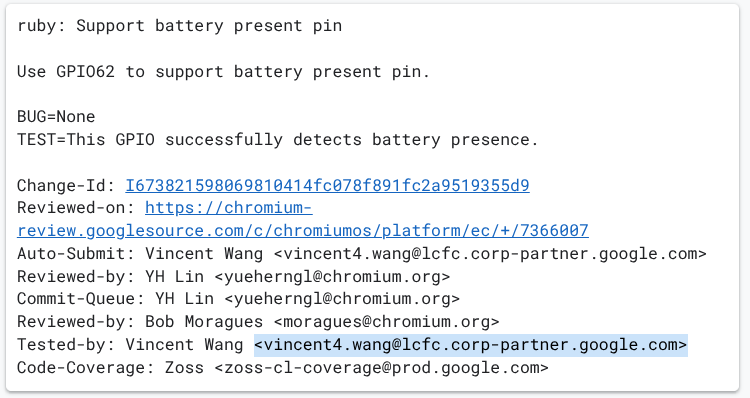

If the email addresses weren’t enough, however, I found a far simpler proof via a coreboot configuration file. A recent commit explicitly adds the Lenovo logo to the boot splash screen for the ‘Ruby’ project. There is no more room for speculation: Lenovo is currently building the two most important Chromebooks on the current roadmap.
Why ‘Ruby’ is important
One of the things that makes ‘Ruby’ a standout is the inclusion of the LED light bar. As we noted yesterday, this feature has historically been the calling card of Google’s own internal hardware team. Seeing it appear on both an ARM tablet and an Intel laptop suggests that Google and Lenovo are working hand-in-hand to create a new generation of “Pixelbook-tier” hardware.
With Intel’s Panther Lake under the hood, ‘Ruby’ will be an absolute beast when it comes to on-device AI tasks. The massive NPU performance in these next-gen chips is exactly what Google needs to run the Android framework and advanced Gemini features natively within the ‘Aluminium’ project.
The Future of ChromeOS is Lenovo?
It is starting to look like Lenovo has become the chosen one to lead ChromeOS through its most significant transition in a decade. By handling both the high-end MediaTek and Intel designs, they are positioning themselves as the premier partner for the new unified OS.
We’ll be keeping a very close watch on ‘Ruby’ as it moves through development. Now that we know who is making it and what’s inside, we’re hunting for details on the screen, the chassis materials, and whether or not that 13-inch BOE panel we found for Sapphire might have a high-resolution Intel sibling.
SUBSCRIBE TO UPSTREAM
Get Chrome Unboxed delivered straight to your inbox
Upstream is our flagship, curated newsletter with the top stories, most click-worthy deals, giveaways, and trending articles from Chrome Unboxed sent directly to your inbox a few times a week. Join 31,000+ subscribers.

