
Support our independent tech coverage. Chrome Unboxed is written by real people, for real people—not search algorithms. Join Chrome Unboxed Plus for just $2 a month to get an ad-free experience, access to our private Discord, and more. Learn more about membership here.
START FREE TRIAL (MONTHLY)START FREE TRIAL (ANNUAL)
The transition from conceptual software to tangible hardware is always a pivotal moment for Google, and with the official arrival of CES 2026, Android XR is making a loud, visual statement.
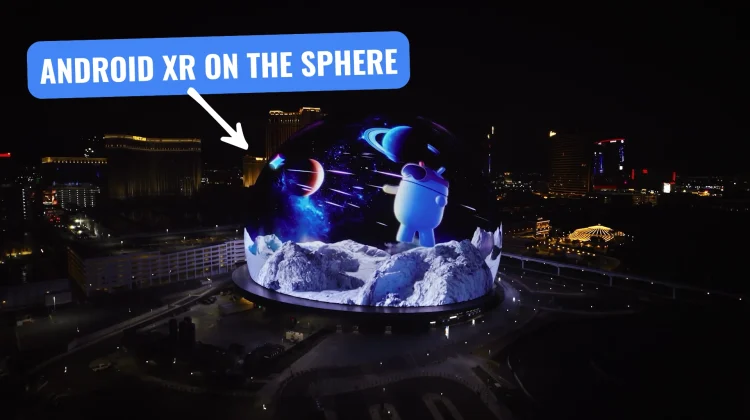
After months of anticipation following the platform’s initial reveal, Google has literally lit up the Las Vegas skyline by turning the Sphere into an immersive showcase for its new spatial computing operating system. It is a bold, larger-than-life display that signals Google’s readiness to compete in a market that has been eagerly awaiting a more open, Android-powered alternative to existing high-end headsets.
The Gemini advantage in spatial computing
What separates Android XR from being just another mobile-to-face port is the deep, situational integration of Gemini. By combining Google’s advanced AI models with a sophisticated awareness of your physical surroundings, the OS is designed to be more of an assistant than a simple interface. Whether you are constructing a persistent virtual workspace or losing yourself in a high-fidelity game, Gemini is built-in to provide real-time help based on what you are actually seeing.
In the Sphere demonstration, you can see the iconic Android bot exploring these capabilities in a way that feels surprisingly practical. From soaring through orbital environments to painting mid-air with precise spatial tracking, the focus is clearly on how AI can transform the way we create and explore. For those of us who have used Gemini on our phones and Chromebooks, seeing it move into a 3D, contextual environment is a natural next step for the ecosystem.
Samsung and the hardware roadmap
The Sphere takeover serves as a massive backdrop for the actual hardware that will define this era. The Galaxy XR has already set a high bar for what Samsung and Google can achieve when they collaborate on hardware and software optimization. However, the real story for 2026 will be how other OEMs adopt Android XR to bring a variety of form factors to market: from tethered glasses to standalone high-performance headsets.
Google is clearly positioning Android XR as the “Android of the XR world” – a flexible, powerful, and AI-driven platform that allows hardware partners to experiment while maintaining a consistent and familiar user experience. As more details emerge from CES this week, it is becoming clear that spatial computing is no longer a niche experiment for Google; it is a core pillar of the future Android roadmap.
SUBSCRIBE TO UPSTREAM
Get Chrome Unboxed delivered straight to your inbox
Upstream is our flagship, curated newsletter with the top stories, most click-worthy deals, giveaways, and trending articles from Chrome Unboxed sent directly to your inbox a few times a week. Join 31,000+ subscribers.

