

Support our independent tech coverage. Chrome Unboxed is written by real people, for real people—not search algorithms. Join Chrome Unboxed Plus for just $2 a month to get an ad-free experience, access to our private Discord, and more. Learn more about membership here.
START FREE TRIAL (MONTHLY)START FREE TRIAL (ANNUAL)
Ever since Google officially launched the new Googlebook platform, one of the biggest questions hanging in the air has been what this means for existing Chromebook hardware. While we wait for official transition paths for existing Chromebook hardware, the enthusiast community isn’t sitting on its hands.
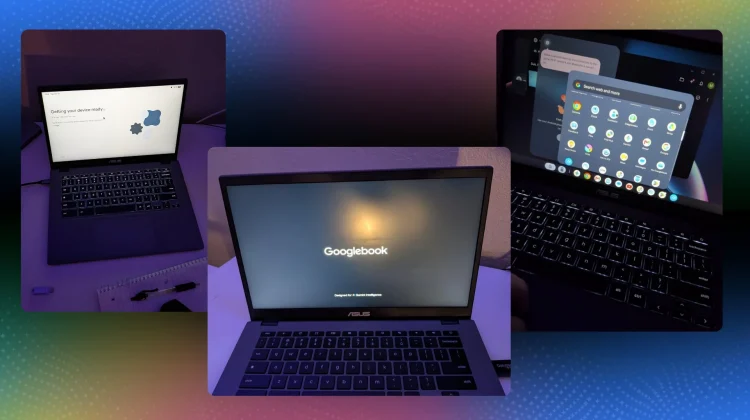
Over on the r/Googlebook subreddit, user u/mawitime shared photos and impressions after successfully booting a “Frankensteined” version of Googlebook OS onto an existing ASUS Chromebook Plus. And while getting an experimental OS to boot on unsupported hardware is a neat party trick on its own, the real headline is how well it actually runs.
Shockingly fast compared to ChromeOS
One of the lingering concerns with Googlebook OS being built on a heavier Android foundation is whether it will bog down older or more modest laptop processors. According to u/mawitime, the exact opposite is true.
Running on an ASUS Chromebook Plus equipped with an Intel Core i5-1235U processor, 16GB of LPDDR5 RAM, and 256GB of UFS 3.1 storage (that’s no slouch), the user noted that the most shocking takeaway was the sheer speed and fluidity of the operating system.
“Easily the most shocking thing is how fast and smooth it is. This is not going to slow down existing machines at all – in some cases it feels even faster than ChromeOS.”
The poster also added in the comments that while their specific machine had 16GB of RAM, the lightweight feel of the system left them confident it would run just fine on standard 8GB configurations as well.
Built with Google Antigravity and community tools
How did they actually pull this off? Ironically, they used Google’s own agentic AI tools to make it all work.
In the thread, u/mawitime explained that they spent several days working alongside Google Antigravity to piece together a bootable build, likely pulling from an official ASUS Googlebook recovery image. Because this was a rough build, plenty of hardware drivers weren’t cooperating out of the gate – leaving essentials like Wi-Fi, audio, and Pixel cross-device integration broken for the time being.
However, the modding community is already organizing. Much like the famous “Brunch” framework that allowed users to install full ChromeOS on standard Windows PCs for years, developers are already tinkering with a new repository called gbrunch aimed at bringing Googlebook OS to unofficial x86 hardware.
A great sign for the future of the platform
While we obviously don’t recommend wiping your daily driver Chromebook to install a driver-less build of Googlebook OS today, seeing it fly on a 12th-Gen Intel processor is fantastic news. It proves that Google’s new desktop architecture isn’t just reserved for bleeding-edge silicon and it has the optimization legs to make existing hardware feel brand new. Stay tuned!
SUBSCRIBE TO UPSTREAM
Get Chrome Unboxed delivered straight to your inbox
Upstream is our flagship, curated newsletter with the top stories, most click-worthy deals, giveaways, and trending articles from Chrome Unboxed sent directly to your inbox a few times a week. Join 31,000+ subscribers.

