
Support our independent tech coverage. Chrome Unboxed is written by real people, for real people—not search algorithms. Join Chrome Unboxed Plus for just $2 a month to get an ad-free experience, access to our private Discord, and more. Learn more about membership here.
START FREE TRIAL (MONTHLY)START FREE TRIAL (ANNUAL)
I banged this drum a bit a couple weeks ago, but another big reason has emerged to prove the point that the Snapdragon X Plus just belongs in a future Chromebook. Thanks to a report from VideoCardz, we now know the estimated cost of the X Plus SoC, and it isn’t just competitive with Intel’s bigger chips: it’s far less expensive.
While overall speed, extensive battery life, and Android app performance are some pretty good reasons why someone should already be at work on a Snapdragon X Plus Chromebook, the news of the potential low price for one of these insanely-capable ARM chips from Qualcomm makes the argument far more interesting.
SoC pricing from Dell’s new XPS with Snapdragon X
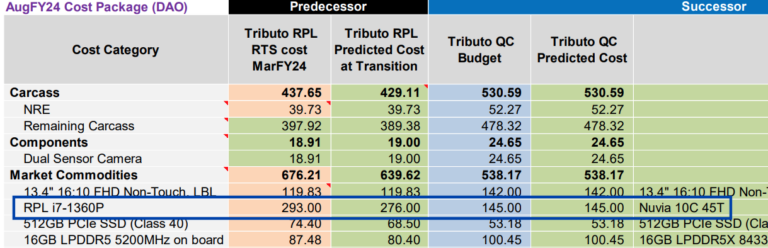
First up, let’s talk numbers. Thanks to the post over at VideoCardz, we know that Dell internally priced the 13th-gen Core i7 around $276 for the number of units they built of their previous XPS laptops. Conversely, they stack up the Snapdragon X Plus they are launching in their latest XPS next to it and the figures are considerably different. The X Plus came in at just $145 per unit: a staggering 47.5% drop in cost. It’s really no wonder they went with the Snapdragon this time around!
Compared with an affordable Chromebook processor
This got me thinking, and I went over to Intel’s site to see their pricing for a few processors. First up, the same 13th-gen Core i7-1360P mentioned in the internal Dell document pictured above lists at $480 for purchases of 1000 units or more. Clearly Dell ordered far more than that, and their price break is evident as they only had $276 in each unit.
Doing a quick bit of math, that comes out to around 57% of the full cost Intel lists for this chip. Taking that same factor and applying it to something like the Core i3-N305 we find in many sub-$500 Chromebooks and you get 57% of $309 – or $177.68.
So, assuming most manufacturers are getting a similar price break on mass orders of Intel’s i3-N305, the Snapdragon X Plus at the same sort of quantity is still cheaper ($145) than the entry-level chip we’re seeing in low-cost Chromebooks. And I would imagine it would outperform it considerably while pushing battery limits up quite a bit as well.
So why in the world aren’t we seeing anyone rush to get the Snapdragon X Plus in a Chromebook? That is beyond me at this point, but I can’t imagine there’s no one working on it right now. I’ve searched the Chromium Repositories and so far I’ve found no evidence of any Snapdragon X work being done, but that doesn’t mean it won’t start next month, next week, or even tomorrow. So I’ll keep looking.
Clearly Qualcomm and Windows laptop manufacturers are focused on getting Windows on ARM right this time around. From what we can tell thus far, they are on the right path. And as the dust settles a bit and some of these devices launch to possibly positive reviews for the first time, maybe we’ll see a change in focus over to the Chromebook side of things. There’s simply no reason for this not to be a thing, and I hope at least a couple manufacturers see it the same way.

